
How to Choose the Right Mortgage Lender When Buying a Home
Choosing the right home is important, but choosing the right mortgage lender can be just as important.
A mortgage lender does much more than quote an interest rate. Your lender helps determine which loan programs you qualify for, how much home you can comfortably purchase, how much cash you may need at closing, and whether your financing stays on track from preapproval through closing day.
And there is another consideration buyers sometimes overlook:
The lender you choose can affect how a seller views your offer.
When buying a home in Kingwood, Humble, Atascocita, Porter, New Caney, Conroe, The Woodlands or the greater Northeast Houston area, you may have a choice between a large national bank, an online mortgage company, a mortgage broker, a credit union or a local mortgage lender.
So, how do you know which one is right for you?
Start With More Than the Mortgage Rate
One of the first questions buyers ask is, “What is your interest rate?”
That’s certainly an important question—but it shouldn’t be the only one.
Two lenders could quote similar interest rates while offering very different loan costs, fees, service and closing timelines. A particularly low advertised rate may also require the buyer to pay discount points or meet certain conditions.
When comparing mortgage lenders, look at the complete loan package, including:
- Interest rate
- Annual Percentage Rate (APR)
- Loan origination and lender fees
- Discount points
- Estimated closing costs
- Mortgage insurance, if applicable
- Down payment requirements
- Available loan programs
- Rate-lock terms
- Estimated monthly payment
- Cash needed to close
- Expected closing timeline
- Communication and accessibility
The Consumer Financial Protection Bureau recommends comparing at least three mortgage offers. Comparing lenders gives buyers a better opportunity to evaluate rates, fees and loan terms instead of simply accepting the first mortgage they are offered.
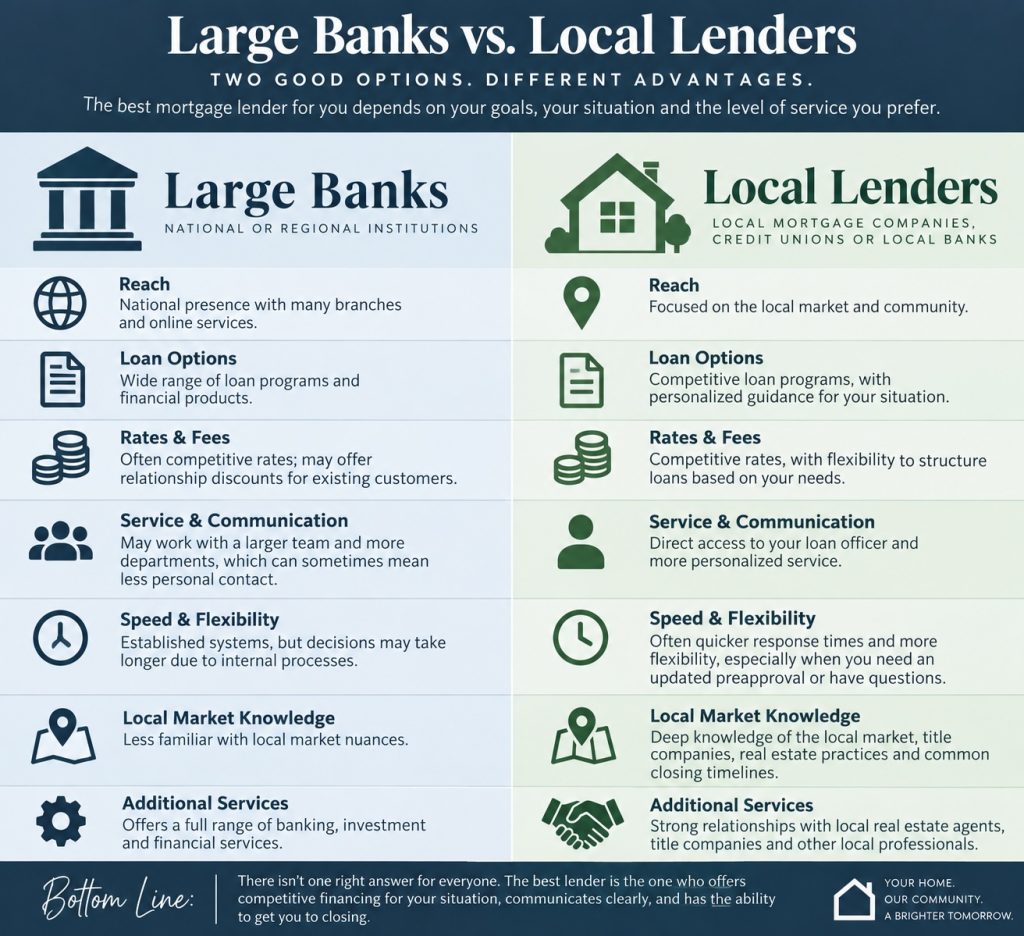
Big Bank vs. Local Mortgage Lender: What’s the Difference?
There isn’t one type of lender that is automatically best for every homebuyer. Large banks and local mortgage lenders can both be excellent choices.
The key is understanding the differences.
Buying a Home With a Big Bank
Large national and regional banks have some obvious advantages. They typically have substantial financial resources, established systems and a wide range of banking services.
If you already have significant deposits, investments or other accounts with a bank, you may also qualify for certain relationship incentives or discounts.
Potential advantages can include:
- Recognizable national brand
- Extensive online banking tools
- Multiple financial services in one place
- Potential relationship discounts
- Competitive loan products and rates
- Established mortgage-processing systems
However, buyers should also consider how the mortgage department operates once they are under contract.
A home purchase involves deadlines. Your real estate agent, title company, lender, appraiser, buyer and seller all need to work together.
Ask who will actually manage your loan after your offer is accepted.
Will you continue working with the same loan officer? Is your loan processed locally or transferred to another department? Who handles questions after normal business hours? How quickly can the lender provide an updated preapproval letter if you find a house on Saturday afternoon?
Those details can become very important during an active home search.
Buying a Home With a Local Mortgage Lender
A good local lender may offer a more personal experience and direct access to the loan officer handling your financing.
Local lenders who regularly work in the Houston, Harris County and Montgomery County real estate markets may also be familiar with local title companies, real estate practices, property taxes, homeowners insurance considerations and common closing timelines.
Potential advantages can include:
- Direct communication with your loan officer
- Local market familiarity
- Faster response times
- Greater accessibility on evenings or weekends
- Familiarity with local real estate agents and title companies
- Ability to quickly update preapproval letters
- More hands-on assistance throughout the transaction
That does not mean every local lender is better than every large bank.
There are excellent loan officers at large banks and poor loan officers at smaller companies. Buyers should evaluate the individual lender and loan officer rather than choosing solely because a company is large or local.
Why Communication With Your Lender Matters
Real estate transactions don’t always happen Monday through Friday between 9:00 and 5:00.
You may find the perfect Kingwood home on Saturday. Offers may be due Sunday evening. Your REALTOR® may need a revised preapproval letter showing the exact offer amount. Can your lender provide it?
Communication also becomes important once you’re under contract.
Your lender may need additional income documentation, bank statements, insurance information or explanations about financial activity. An appraisal must be ordered. The loan must move through processing and underwriting. Conditions need to be cleared before closing.
A lender who communicates clearly can help keep these moving pieces organized.
Before choosing a lender, ask:
“If I have a question or need an updated preapproval letter outside normal business hours, how do I reach you?”
The answer can tell you a lot about the service you can expect.
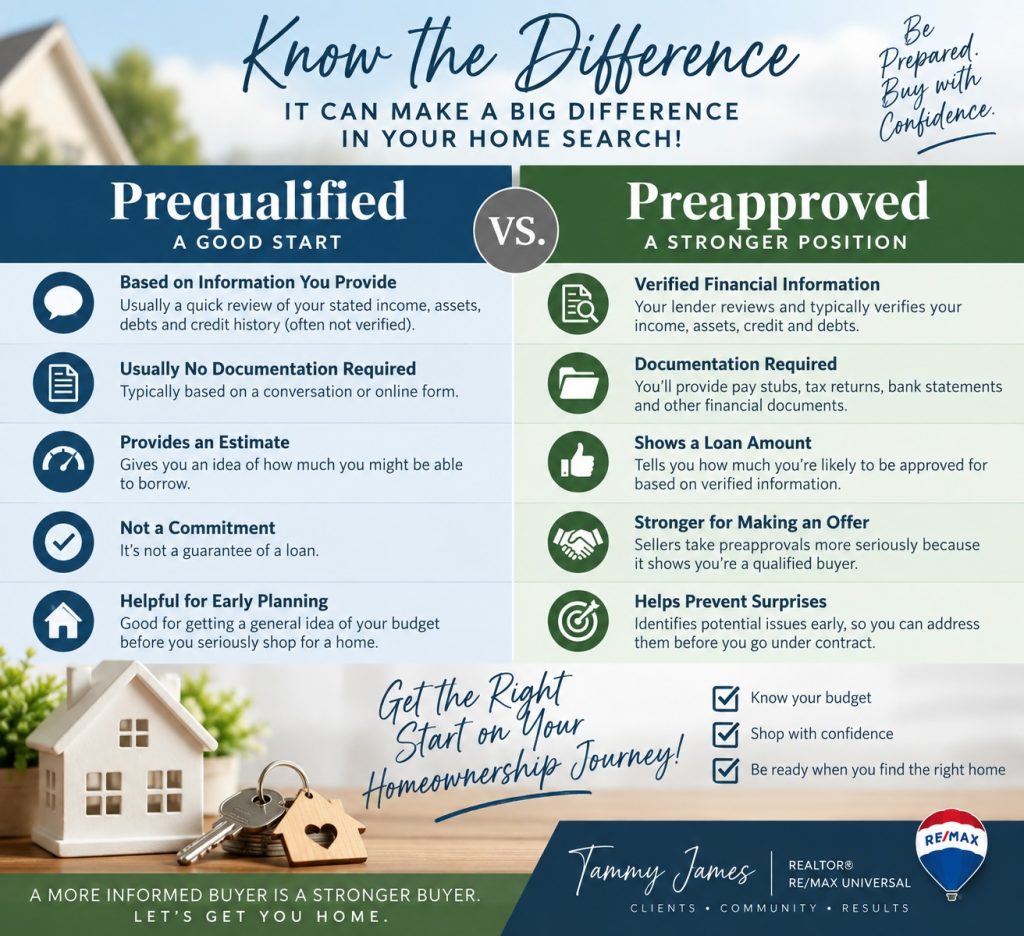
Prequalified vs. Preapproved: Know the Difference
Before seriously shopping for a home, talk to a lender about obtaining a strong mortgage preapproval.
A basic prequalification may be based largely on information the buyer provides. A more thorough preapproval generally involves verification of financial information such as income, assets and credit.
Ask your lender exactly what they reviewed.
For example:
- Was my credit reviewed?
- Was my income documentation reviewed?
- Were my assets verified?
- Was my debt-to-income ratio calculated?
- Has an automated underwriting system reviewed my information?
- Are there any potential issues that could affect final approval?
The more thoroughly your financing has been reviewed before you make an offer, the better prepared you may be for the mortgage process after going under contract.
A preapproval is still not a guarantee of final loan approval. The property must also meet applicable requirements, and the borrower’s finances generally need to remain qualified through closing.
What Does a Home Seller Look for in a Buyer’s Offer?
Price matters, but sellers don’t necessarily look only at the highest number.
A seller wants to know:
Is this transaction likely to close?
When a seller receives multiple offers, the listing agent may help the seller evaluate several factors, including:
- Purchase price
- Type of financing
- Down payment
- Earnest money
- Option period and option fee
- Requested seller concessions
- Proposed closing date
- Appraisal-related terms
- Other contingencies
- Strength of the buyer's financing
- Preapproval documentation
The reliability of the buyer’s financing can therefore become part of the overall picture
The Lender Can Make a Difference
Imagine a seller receives two similar offers.
Buyer A submits a generic prequalification letter from a lender the listing agent cannot easily reach.
Buyer B submits a detailed preapproval from a responsive lender who has reviewed the buyer’s financial information and is willing to answer reasonable questions about the buyer’s qualification without disclosing confidential financial information.
If the offers are otherwise similar, the seller may feel more confident about Buyer B’s ability to reach closing.
That doesn’t mean a seller should automatically prefer a local lender or reject an offer because it comes with financing from a large bank.
It means certainty and confidence matter in a real estate transaction.
Why Sellers Care About the Buyer’s Financing
Once a seller accepts an offer, the home generally moves into pending status while the buyer works toward closing.
If the buyer’s financing falls apart several weeks later, the seller may have lost valuable market time and may need to put the property back on the market.
That’s why sellers and listing agents pay attention to financing.
A strong lender can help provide confidence that the buyer has been properly evaluated and that the lender understands the contract deadlines.
This can be especially important in a competitive market where a seller has several offers from which to choose.
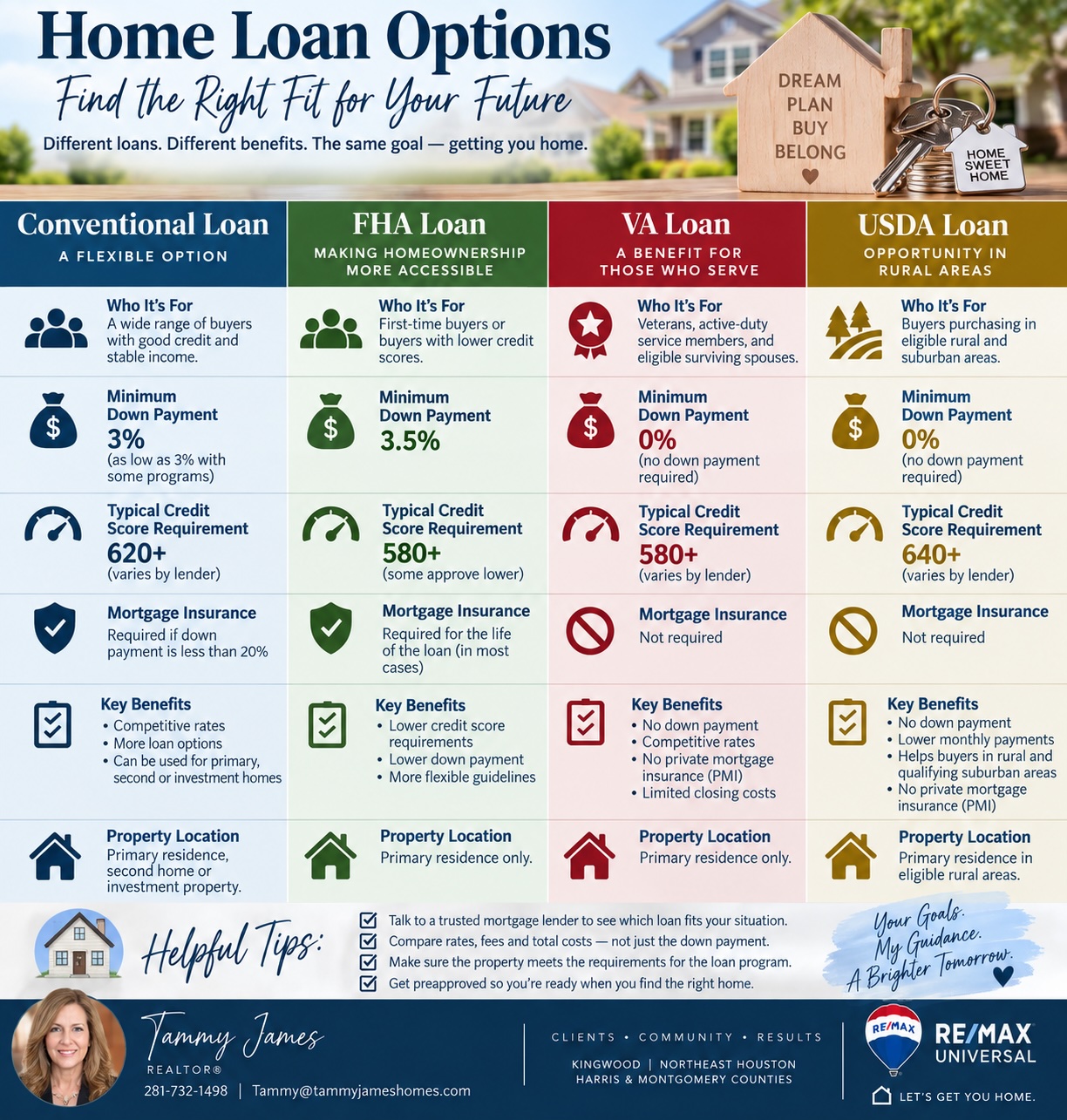
What About FHA, VA and Conventional Loans?
The right loan program depends on your finances, eligibility, property and long-term goals.
Common mortgage options include:
Conventional loans – Popular with many buyers and available with a variety of down-payment options.
FHA loans – Government-insured mortgages that can provide an option for buyers who meet FHA guidelines.
VA loans – A valuable home-financing benefit available to eligible veterans, active-duty service members and certain surviving spouses.
USDA loans – Financing that may be available for qualifying borrowers and eligible properties in designated areas.
There can also be first-time homebuyer and down-payment-assistance programs available to qualifying Texas buyers.
Don’t assume one program is automatically better than another. Ask your lender to explain why a particular mortgage fits your circumstances and compare the short- and long-term costs.
Questions to Ask Before Choosing a Mortgage Lender
Before deciding who will finance your home purchase, ask several lenders the same questions:
- What mortgage programs do I qualify for?
- What interest rate and APR are you quoting?
- Does that rate require discount points?
- What are your lender and origination fees?
- What is my estimated monthly payment, including taxes and insurance?
- Approximately how much cash will I need at closing?
- How long is the rate lock?
- What happens if closing is delayed?
- How quickly can you close a purchase loan?
- Who will process and underwrite my loan?
- How can I reach you after business hours or on weekends?
- Can you provide updated preapproval letters when I’m making an offer?
- What could potentially prevent my loan from closing?
- Are there down-payment-assistance or first-time-buyer programs I should consider?
- Will you clearly explain my Loan Estimate and closing costs?
Pay attention to how the lender answers.
A knowledgeable lender should be willing to explain the mortgage in terms you understand rather than rushing you into a particular loan
Compare Loan Estimates—not Just Advertised Rates
Once you are far enough into the mortgage process to receive Loan Estimates, compare them carefully.
Look at the interest rate, APR, points, lender fees, estimated monthly payment and total estimated cash to close.
Comparing lenders on the same day can also be helpful because mortgage rates can change frequently.
Freddie Mac recommends obtaining quotes from multiple lenders and comparing the overall cost rather than looking only at the interest rate.
A slightly lower rate isn’t necessarily a better deal if obtaining it requires substantially higher upfront costs.
Don’t Forget to Check the Lender or Loan Originator
Texas buyers can also verify mortgage licensing or registration.
The Texas Department of Savings and Mortgage Lending regulates much of the residential mortgage industry in Texas and directs consumers to the Nationwide Multistate Licensing System (NMLS) Consumer Access database to check licensing information.
This is a simple step that can be worthwhile before providing sensitive financial information to someone you don’t know.
Your REALTOR® and Lender Should Work as a Team
A successful home purchase requires coordination.
Your REALTOR® handles the real estate side of the transaction while your mortgage lender handles financing. Each has a different role, but communication between the two can be extremely valuable.
For example, I may need to communicate with a buyer’s lender about:
- The targeted closing date
- Financing deadlines in the contract
- Preapproval updates
- Property information
- Appraisal scheduling or status
- Loan progress
- Closing readiness
Your lender should never share confidential financial information without authorization, but they should be able to communicate effectively about transaction milestones.
Should You Use the Lender Your REALTOR® Recommends?
You are free to choose your own mortgage lender.
When a REALTOR® provides the names of lenders they have successfully worked with, the recommendation may be based on previous transactions—communication, reliability, problem-solving ability and whether those lenders consistently got qualified buyers to closing.
But you should still compare.
Ask for recommendations, talk to your bank, interview local lenders and compare mortgage terms.
The final choice should be yours.
Choosing a Mortgage Lender in Kingwood and Northeast Houston
If you’re preparing to buy a home in Kingwood, Humble, Atascocita, Porter, New Caney, Conroe, The Woodlands, Crosby, Huffman or another Northeast Houston community, don’t wait until you’ve found a house to start thinking about financing.
Getting your financing organized early can help you:
- Establish a realistic home-buying budget
- Identify the right loan program
- Estimate your monthly payment
- Understand your closing costs
- Address potential financing problems early
- Be prepared when the right home becomes available
- Submit a stronger, better-prepared offer
- Establish a realistic home-buying budget
- Identify the right loan program
- Estimate your monthly payment
- Understand your closing costs
- Address potential financing problems early
- Be prepared when the right home becomes available
- Submit a stronger, better-prepared offer
The right mortgage lender isn’t necessarily the biggest company, the smallest company or the lender advertising the lowest rate.
The right lender is the one who offers competitive financing for your situation, communicates clearly, understands your goals and has the ability to help get you successfully from preapproval to closing.
Ready to Start Your Northeast Houston Home Search?
Buying a home involves more than finding a property you love. Financing, contracts, inspections, negotiations, appraisal and closing all have to come together.
As an experienced and trusted Kingwood and Northeast Houston REALTOR®, I help buyers understand the entire process—from preparing to make an offer through closing and beyond.
Whether you’re considering a home in Kingwood, Humble, Atascocita, Porter, New Caney, Conroe, The Woodlands or the surrounding Houston area, contact Tammy James, REALTOR® with RE/MAX Universal, to discuss your home search and the steps you can take to become a well-prepared buyer.
The better prepared you are before you find the house, the stronger position you’ll be in when it’s time to make an offer.
Frequently Asked Questions About Choosing a Mortgage Lender
Neither is automatically better. A large bank may offer competitive rates, established technology, multiple financial products, and relationship discounts for existing customers. A local mortgage lender may provide more direct communication, faster response times, and greater familiarity with the Houston-area real estate market. The best choice is the lender that offers competitive overall loan terms, communicates well, and can reliably meet the deadlines in your home purchase contract.
Yes, it can. Sellers want confidence that the buyer has the financial ability to complete the purchase. A solid preapproval from a responsive lender can help demonstrate that your financing has been reviewed. This can be especially important when a seller is comparing multiple offers. However, the lender is only one part of an offer; price, financing type, contingencies, seller concessions, closing date, option period, earnest money, and other terms can also influence a seller’s decision.
Prequalification is generally an initial estimate of how much you may be able to borrow based on financial information you provide to a lender. A preapproval typically involves a more detailed review of your credit, income, assets, debts, and other financial information. Because lender procedures vary, ask exactly what was verified before relying on a preapproval letter.
No. A mortgage preapproval is not a guarantee of final loan approval. Your lender will still need to complete underwriting, verify required information, and determine that both you and the property meet the loan program’s requirements. Changes to your employment, income, credit, debts, or finances before closing could also affect your eligibility.
It’s a good idea to compare at least three lenders. Don’t compare only the advertised interest rate. Look at the APR, lender fees, discount points, closing costs, rate-lock terms, mortgage insurance when applicable, estimated monthly payment, and total cash needed to close. You should also consider the lender’s communication and ability to meet your closing timeline.
It depends on the mortgage program and the buyer’s qualifications. Some conventional loan programs allow down payments as low as 3%, while FHA loans may require as little as 3.5% for qualifying borrowers. Eligible VA and USDA borrowers may qualify for 0% down financing. Loan requirements vary, so buyers should speak with a qualified mortgage professional about their specific circumstances.
No. The idea that every buyer needs a 20% down payment is a common misconception. Many mortgage programs permit substantially smaller down payments. Putting less than 20% down on a conventional mortgage may result in private mortgage insurance (PMI), while FHA, VA, and USDA loans have their own insurance or funding-fee structures and requirements.
There isn’t one mortgage that’s best for everyone. Conventional financing may work well for borrowers who meet its qualification requirements. FHA financing can offer more flexible qualification standards for some borrowers. VA loans provide significant benefits to eligible veterans, active-duty service members, and certain surviving spouses. USDA loans can provide zero-down financing for eligible borrowers purchasing qualifying properties in eligible areas. A lender should compare the programs available to you rather than automatically placing you into one type of loan.
Not necessarily. Sellers generally want an offer that provides attractive terms and a strong likelihood of closing. Financing type can be one consideration, but sellers may also evaluate price, requested concessions, contingencies, appraisal terms, closing date, earnest money, option period, and the buyer’s overall financing strength. A well-qualified FHA or VA buyer can still present a strong offer.
A seller and listing agent may look at whether the buyer appears qualified for the financing stated in the offer and whether the preapproval supports the proposed purchase price. They may also consider the type of loan and the lender providing the letter. A responsive lender who can appropriately confirm the buyer’s qualification can provide additional confidence without disclosing the buyer’s confidential financial information.
You are not required to use a lender recommended by your REALTOR®. However, an experienced real estate agent may be able to provide names of lenders they have successfully worked with in previous transactions. Those recommendations may be based on communication, responsiveness, knowledge, problem-solving, and the lender’s history of getting transactions to closing. Buyers should still compare lenders, rates, fees, and loan programs before making their own decision.
Not based on the rate alone. A lender advertising a lower interest rate could charge higher fees or require you to purchase discount points. Compare the total cost of the mortgage, including the interest rate, APR, points, lender fees, closing costs, mortgage insurance, and rate-lock terms. Service and reliability are also important when you’re working toward a contractual closing date.
Ideally, get preapproved before you seriously begin touring homes. This helps establish your price range and estimated monthly payment before you fall in love with a property. It also puts you in a better position to make an offer quickly when you find the right home.
It may be possible, but changing lenders after you’re under contract can create complications. Texas real estate contracts contain important financing and closing deadlines, and changing lenders could affect your ability to meet them. Before making a change, discuss the timing and potential contract implications with your REALTOR® and speak with the new lender about whether they can meet the required deadlines.
Compare several lenders and evaluate more than the interest rate. Look for competitive loan terms, reasonable fees, strong communication, availability, experience with your loan program, and the ability to meet contract deadlines. Buyers purchasing in Kingwood, Humble, Atascocita, Porter, New Caney, Conroe, The Woodlands, Crosby, Huffman, Harris County, or Montgomery County may also benefit from working with a lender familiar with the local real estate market and Texas home-buying process.
Look for a combination of competitive financing, transparency, communication, reliability, and experience. The cheapest-looking loan isn’t always the best mortgage, and the biggest lender isn’t necessarily the best lender. You want a mortgage professional who explains your options clearly and can help move your financing from preapproval through closing.